The New Horsemen
Malthusian modernity and what comes next for Britain.

In Malthusian Fetters, I demonstrated that Britain has become a Malthusian subsistence economy with declining living standards. Most people live month-to-month, with minimal savings and stagnant, while persistent inflation squeezes their incomes ever tighter. Productivity growth is almost flat, meaning economic output grows arithmetically and is therefore outpaced by the rising population, exacerbated by mass immigration. Subsistence living combined with constrained output and rising population gives rise to the Malthusian fetters as output — what we need to live — is divided up amongst ever more people, forcing living standards down.
The Malthusian fetters, or checks, are preventative and positive. The former relates to declining birth rates, caused by delayed marriage and reduced number of children; I demonstrated this is clearly in effect in Britain, with average marriage ages rising precipitously while the fertility rate trends ever downwards.
The positive fetter relates to rising death rates. Historically, these were calamitous: war, famine and disease, simultaneous with a period of disorder, unrest and strife. The Horsemen of the Apocalypse, in effect. In the modern world, however, at least for a developed economy like Britain, this traditional model does not appear appropriate. Famine — true famine, not certain dietary luxuries becoming rarer — seems functionally impossible; epidemics, similarly, while functionally possible, in practice seem unlikely to cause cataclysmic numbers of deaths as they did historically (see Covid-19). So, what is the positive check today, and how might that look in Britain?
In this article, I will attempt to answer those questions. This will inherently involve more speculation than Malthusian Fetters as we pass from what has happened to what may happen, though I will draw on data when possible. Firstly, I will consider what the Malthusian positive check looks like for a modern, developed economy. To do this properly, I must begin by considering whether famine and epidemics are able to operate as positive checks today. After that, I will assess what other forms the positive check might take.
Apologies in advance: this will be grim in tone.
The black horseman
“…And I beheld, and lo a black horse; and he that sat on him had a pair of balances in his hand.
And I heard a voice in the midst of the four beasts say, A measure of wheat for a penny, and three measures of barley for a penny; and see thou hurt not the oil and the wine.” — Revelation 6:5-6
Britain has long been an importer of food, hence the U-boat campaigns of WWI and WWII; indeed, even in the Napoleonic Wars, Britain imported grain to feed itself. Presently, the UK imports 40% of its overall food consumption and 25% of indigenous (can be grown in the UK) food consumption1. This has remained stable since the start of the century, and is much lower than in 1939, when c.70% was imported.
UK production varies considerably by product type2:
Cereals (wheat, barley and oats), 93% of consumption;
Milling wheats (for fortified flour), 85% of consumption;
Potatoes, 63% of consumption;
Milk, 105% of consumption;
Poultry, 82% of consumption;
Sheepmeat, 114% of consumption;
Beef, 85% of consumption;
Pork, 64% of consumption;
Eggs, 87% of consumption;
Fresh vegetables, 53% of consumption; and
Fresh fruits, 16% of consumption.
Broadly, these figures suggest reasonable self-sufficiency in most of the critical produce. There is complexity in that, for example, a lot of cereals production is used for animal feed rather than human consumption (so a fall in production would have knock-on effects on meat self-sufficiency) and production will be contingent on weather. Fresh fruits and vegetables are a notable weaker area, though the former is driven in large party by imports of non-indigenous produce (e.g. citrus and tropical fruits), and both are easily capable of being preserved e.g. tinning and freezing.
In terms of production then, famine appears unlikely. An analogue may be WWII, the privations of which Britain was able to endure — food imports (70% of consumption in 1939) fell by almost half by the end of the War in volume terms — through use of rationing, preservation, forgoing of imported non-indigenous food and greater domestic production. Should the need arise, I expect this could be done again, likely more easily given today’s lesser reliance on imports.
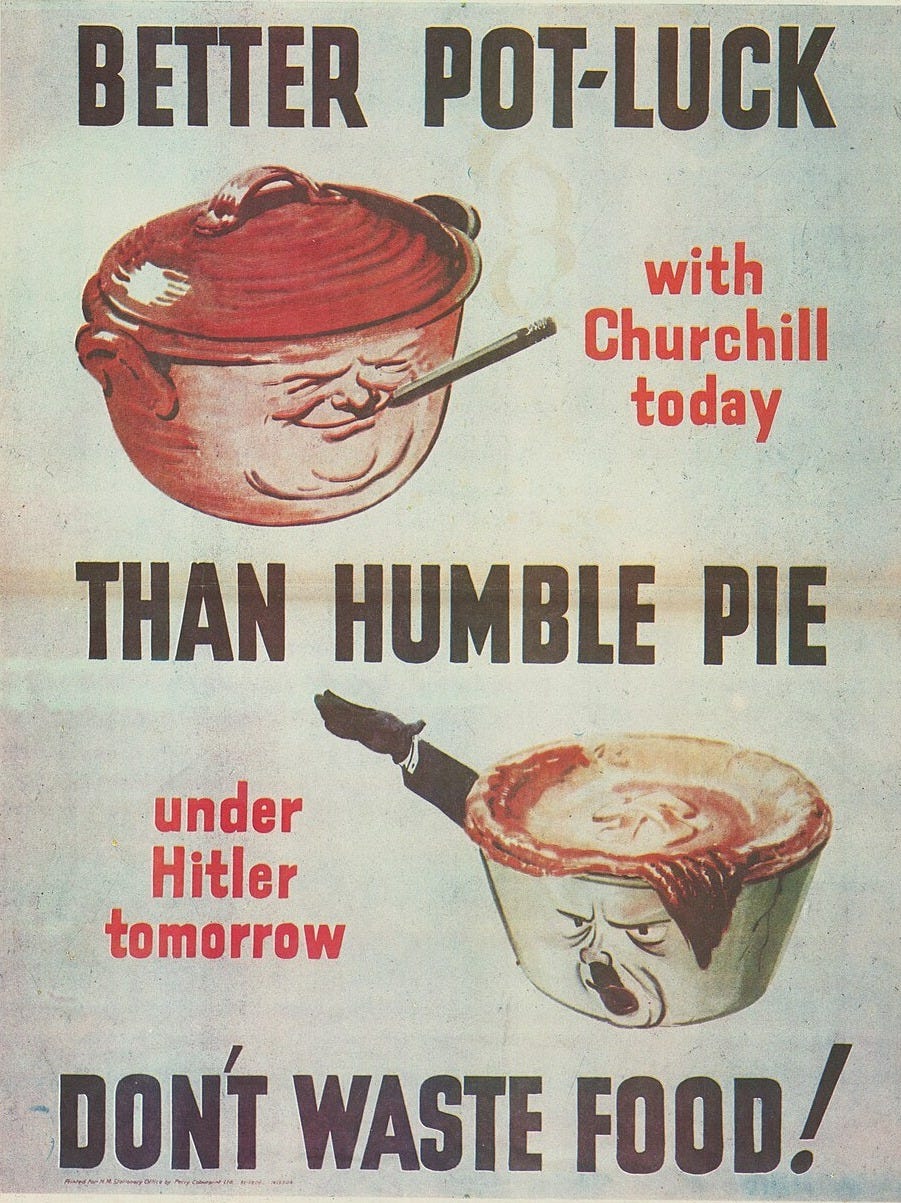
A different dimension of this is the food supply chain. People source their food differently now, largely relying on supermarkets, which have highly sophisticated supply chains. They may well add more resilience to Britain’s food supply. There is perhaps a question about technological and digital vulnerabilities — how reliant these systems are on various internet and digital technologies which could be disrupted — but I would hazard to guess these can be handled if push came to shove, though there could well be short-term disruptions and shortages.
The spectre of epidemics
Disease, particularly infectious disease, was for most of human history our principal killer. In the Malthusian framework, greater population density and constrained resources make the population more vulnerable to disease and epidemics, increasing deaths to bring down the population. While (in developed countries) it does still happen, it is rare, and usually happens in combination with other conditions and general ill-health. The achievements of modern medicine have become so standard and ubiquitous that we do not appreciate them; the notion of someone dying of appendicitis, cholera or tuberculosis seems antiquated.
Modern medicine has not banished the epidemic and pandemic, though it has made them rarer and far less deadly. The great Plagues of history, which saw almost incomprehensible death tolls, no longer seem possible. Covid, the nearest present analogue, had a death rate of about 2%3, which is low by historical pandemic standards. Novel diseases, like Covid, pose more of a threat, and even then the death rate was relatively low due to the quality of medical technology and treatments, as well as rapid development of vaccination.
It therefore seems unlikely that we face a serious risk of epidemics and pandemics of sufficiently deadliness to act as a Malthusian check on the population and economy. There is a potential question of man-made diseases and bio-weapons (see the lab leak origin for Covid), which could be highly dangerous, but that is not a Malthusian dynamic deriving from declining living standards per se.
The new horsemen?
So, the old ‘horsemen’ of famine and disease seem less relevant to the modern economy. The traditional positive check therefore does not exist anymore. This poses a problem: the Malthusian trap of declining living standards resolves through the positive check reducing population to within the means of the economy’s output to sustain it, causing living standards to improve again. How does the cycle resolve now?
Simply put, it does not, of its own accord.
At this point, it is worth re-iterating the causes of Malthusian Britain that I identified in Malthusian Fetters:
Persistent inflation, particularly of essential goods, eroding wages;
Mass immigration of low-skilled workers suppressing wages and productivity; and
Chronically low investment, impeding and constraining productivity growth.
This ‘unholy trifecta’ is responsible for turning Britain into a Malthusian economy. They are all a product of government policy, the cumulative results of some three or four decades worth of policy decisions. Modernity has negated the positive check, meaning the cycle cannot resolve on its own; as long as this trifecta remains in place, the Malthusian fetters will continue to bind Britain, steadily tightening as living standards further decline and the economy remains stagnant.
Negating the positive check is a great achievement, perhaps the greatest of human history; escaping the confines of famine and diseases has been a liberation for humanity. The issue is that the unholy trifecta has fettered the British economy and condemned us to this Malthusian existence.
Releasing these fetters will require a systematic dismantling of the structure of the British State and economy as it has been constituted since the 1990s. It is a great undertaking, but a noble one, and — I would say — simpler than it initially appears, if the agent of change is willing to ignore the howls of protest from the vested interests, rentiers and ideologues who have profited most from the self-imposed fettering.
Here I will consider the negative case, where the unholy trifecta is not undone and so the fetters continue to bind. While the traditional positive check no longer exists, I contend that there is a modern analogue to it in the case of Britain, or rather two complementary analogues:
Deteriorating public and essential services which, for most, are necessary for modern life; and
Political disorder and civil strife.
These are the ‘new horsemen’ which now threaten us. I do not intend this piece alarmist; rather, it is an honest, if bleak, extrapolation of the trends I see already well underway in the UK. It is, however, a warning of what may be to come if we carry on as we have been.
The fraying public realm
Their ubiquity makes it easy to forget the breadth of public and essential services which are necessary to modern life. There are the obvious such as the NHS, but many others besides: roads and railways, water and sewage, waste removal (‘the bins’), power, internet4; modern life all-but requires these. Any deterioration in them will therefore negatively impact living standards, potentially quite severely over time.
Unfortunately, the signs of decline are easy to see. Let us start with the NHS, given its prominence in public life; it has a variety of performance targets which, while of perhaps questionable value in ensuring quality, do provide useful benchmarks to measure against. To look at a few:
The NHS has a target 95% of A&E patients being admitted, transferred or discharged within four hours. In 2008, about 98% of patients were seen in four hours; by 2025, this was running at about 75%.5
Ambulances have a response time target of seven minutes for life-threatening (C1) calls and 18 minutes for emergency (C2) ones. Since 2017/18, when the present framework was implemented, they (nationally) have never met either target, with response times for emergency calls being on average half- to twice as long as they should be in recent years.6
Elective treatment has a target of 92% of patients starting treatment within 18 weeks of being referred (the RTT target). In 2008, the first year of this target, it was met for 87% of patients. After being >90% consistently for the early 2010s, it then started to decline in 2015, and by 2025 it had fallen to about 62%.7
The aspect of this rarely addressed in the media or by government is the increase in demand; for example, A&E attendances totaled 19.3m in 2008, compared to 27.8m in 20258, while life-threatening and emergency ambulance call outs increased from c.5m in 2018 to c.5.6m in 2025.9
For power, consumer electricity prices have increased by 209% (i.e. three times) since 2008; for transport, rail fares have increased by 75%; for housing, rents have increased by 70% (more in many cities)10. Given stagnant real wages, these essentials are therefore becoming less affordable, forcing households to either cut back (e.g. hold out a few more weeks before putting the heating on) or cannibalise other spending to keep using them.
The picture then is clear: public and essential services, either in their quality or affordability, have been markedly deteriorating in recent decades. In the absence of a solution, there is no reason to believe that these trends will, on the whole, reverse.
That will serve to erode living standards, acting in the manner of a positive check: premature death from cold, dying earlier from absence of medical treatment, poorer diet, more stress, and so on will perniciously shorten lifespans and make life in general more miserable and lower quality. It is not as severe as the old positive checks of famine and epidemic by any stretch, but has the same effect: forcibly shunting us to a lower (sustainable) standard of living and all that entails.
The reasons for this will, to some degree, vary between service, but there are two common themes: rising demand from rising population; and supply (i.e. availability of the service) constraints.
I alluded to rising demand for NHS services above. By official figures, the UK population has increased by 12.4% since 200811, which will naturally increase demand for public and essential services. Most of this increase — about three-quarters — is from direct immigration, and a further share of it will be the children of immigrants. As such, there is a built-in ratchet effect on demand. Higher demand in turn necessitates more supply to maintain quality or affordability.
Where does that supply come from? Ultimately, it must be built and/or recruited. That costs money, which in many cases comes from government, directly or indirectly. For example, government directly spends to expand NHS provision, while it indirectly spends on many others e.g. power, railways and housing, which are subsidised by government in various ways. Increasing provision of these public and essential services therefore requires more government spending. The size of those costs will be in part a function of how much more provision there needs to be, but also how difficult it is to create new provision.
The latter ultimately feed into costs. The more barriers and obstacles there are to building new provision, for example planning and regulations, the slower and more burdensome the process will be, increasing costs directly (from compliance) and indirectly (from delays). This is certainly a problem in the UK — a cursory glance at the travails of HS2 and the Hinkley Point C and Sizewell C nuclear power plants shows that — but here, for parsimony, I will focus on costs and spending.
The Sword of Damocles
“In the middle of this luxury, Dionysius [ruler of Syracuse] ordered that a shining sword, fastened from the ceiling by a horse-hair, be let down so that it hung over the neck of that fortunate man [Damocles]. And so he [Damocles] looked neither at those handsome waiters nor the wonderful silver work, nor did he stretch his hand to the table…” — Cicero, Tusculanae Disputationes 5.61
I have established then that rising demand for public and essential services, caused by population growth primarily due to immigration, is in turn driving up public spending. Since 2007/8, government spending has increased by about one-third in real terms12 yet, as determined above, the quality and affordability of public and essential services has declined; for health, spending increased by over 50%13. Demand growth has outstripped supply growth. The fiscal health of the UK has also deteriorated over this period, the national debt rising from about 48% of GDP (output) at the end of 2008 to about 95% today14 due to chronic budget deficits.
In theory, this is odd. Government tax revenue ought to rise in line with growing output as incomes rise and businesses grow; in effect, if the government takes a fixed share of output as tax, then rising output gives rising tax. Ordinarily, that should roughly make up for any rising spending needs from growth (such as a higher population). The answer to this conundrum lies in what I showed in Malthusian Fetters: namely, the UK has effectively geometric (2, 4, 8,…) population growth constrained by arithmetic (1, 2, 3,…) output growth.
There, I discussed how this trap leads to declining living standards. I have expanded upon that argument above. Now, I will consider the fiscal dynamics. Simply put, the faster population increases, the faster demand for public and essential services will rise, and hence the faster government spending will need to increase to allow supply to keep pace.
If population — and hence spending requirements — are rising geometrically, then tax revenue will need to rise geometrically as well. But output is rising arithmetically, meaning tax revenue can only naturally rise arithmetically as well. Spending therefore inherently outgrows revenue. That necessitates tax rises to try to make up the shortfall — indeed, tax revenue as a share of GDP has increased from c.37% to c.40% over 2008-25 and is expected to rise further15 — but higher taxes suppress economic growth, reinforcing the arithmetic output problem. Thus, the government has also turned to borrowing, hence the rising debt levels.
This is the fiscal ‘sword of Damocles’ hanging over the UK which threatens crisis. There has been much speculation about bond yields, panics and IMF bailouts; in short, I think it will happen, and rather soon-ish. What matters more, however, is what comes after that: is there a resolution to the Malthusian fetters, or only a short-term bodge? Either will involve some immediate pain, but the latter — where the trifecta of high inflation, high immigration and low investment is not broken — will simply perpetuate the problems, with the pressure on living standards and public finances persisting.
A House Divided
“Every kingdom divided against itself is brought to desolation, and every city or house divided against itself cannot stand.” — Matthew 12:25
Assuming an impending fiscal crisis does not provide the impetus for the wholesale reform required to escape the Malthusian fetters, what then happens? I will give my view in what follows. While this is inherently speculative, I do not think it unrealistic.
The essence of this scenario is that living standards continue to be squeezed. Historically, when faced with deteriorating living standards, the people would revolt; at heart, democracy offers an alternative: vote out the government and elect a new one to fix the problems. Revolt and revolution are no longer necessary. This was the calculus made by European states in the 19th century; democracy was a preferable outcome to revolution. But what happens when democracy no longer seems able to deliver a solution?
This is where we increasingly appear to find ourselves. Trust in politicians has been long in decline and belief in the traditional two parties, whose combined vote share has been steadily falling over the last thirty years (barring 2017 and 2019). Insurgent parties have come to the fore (this first began in Scotland with the SNP), promising change and something different. Political disorder and instability — weak, short-lived governments — is a consequence of all this, and would likely continue into the future.
There is another consequence, namely civil strife. We have begun to see the seeds of this too; consider the furore over the Israel-Gaza war, the attacks on defence facilities by Pro-Palestine activists, attacks on Jews, the protests at migrant accommodations, and the unrest and riots after the Southport murders, the verdict in the Nowak murder and in Belfast. Immigrants and immigration — one of the main causes of Britain’s present Malthusian predicament — run, directly or indirectly, through all of this.
It is not a stretch to imagine this continuing and escalating as the squeeze on living standards tightens, especially in cities, where it is already most pronounced given higher costs of living and greater immigrant populations. Vigilantism, tit-for-tat attacks, different groups ‘protecting’ themselves, local government and state institutions either being bypassed or hijacked while central government appears impotent and powerless; that is a pattern I could well see emerging in the coming years. The recent violence in Belfast is perhaps a premonition.
Ireland offers two good examples of this: the Troubles and the Irish War of Independence (1919-21). Both were relatively ‘low-level’ conflicts rather than civil wars in the traditional sense, exhibiting many of the characteristics outlined above. Although there is a vivid reputation for violence in these two cases, the number of deaths were relatively low (c.3,500 for the Troubles over about 30 years, c.2,500 for the War of Independence). I do not expect a one-to-one repeat of those conflicts (and certainly not the conflict with the State) but they perhaps signal the kinds of unrest and strife that could be expected.
I am of course speculating here, but this seems like a plausible position for Britain to be in in, say, ten or fifteen years if the Malthusian fetters are not broken, given where we are currently. I hope it will not happen, but it does no harm to consider the worst and hope for the best. Apologies for the gloomy piece.
QCMP
DEFRA, Food Security Report 2024, Theme 2: UK Food Supply Sources. Figure for 2023.
Ibid. Figures for 2023.
Some of these are privatised, but a) that does not impinge on their necessity, and b) they are heavily regulated and work closely with government.
NHS: A&E Attendances and Emergency Admissions, Quarterly Annual Time Series. This is England-only, though a similar trend can be observed in the rest of the UK.
NHS: Ambulance Quality Indicators, AmbSys time series to May 2026. As above, this is England-only.
NHS: RTT Waiting Times, Admitted Commissioner dataset.
NHS: A&E Attendances and Emergency Admissions, Quarterly Annual Time Series.
NHS: Ambulance Quality Indicators, AmbSys time series to May 2026.
All ONS: Electricity, rail fares and rent. Measured Jan 2008 – Jan 2026.
ONS: UK population mid-year estimates. 2008-2025. Given net immigration is likely an underestimate, the true overall population increase since 2008 is likely larger.
Public Spending Statistics. Expenditure on services dataset, Table 9a (TME).
Ibid.
OBR: A brief guide to the public finances, Deficits and surpluses.